Point of Care Ultrasound and Shockwave Therapy: A More Informed Approach for MSK Clinicians
Shockwave therapy is now widely used across MSK practice, particularly for tendinopathies and long standing soft tissue conditions. As more clinics introduce it, a simple question is coming up more often. Are we treating the right structure, or just the area that feels most painful?
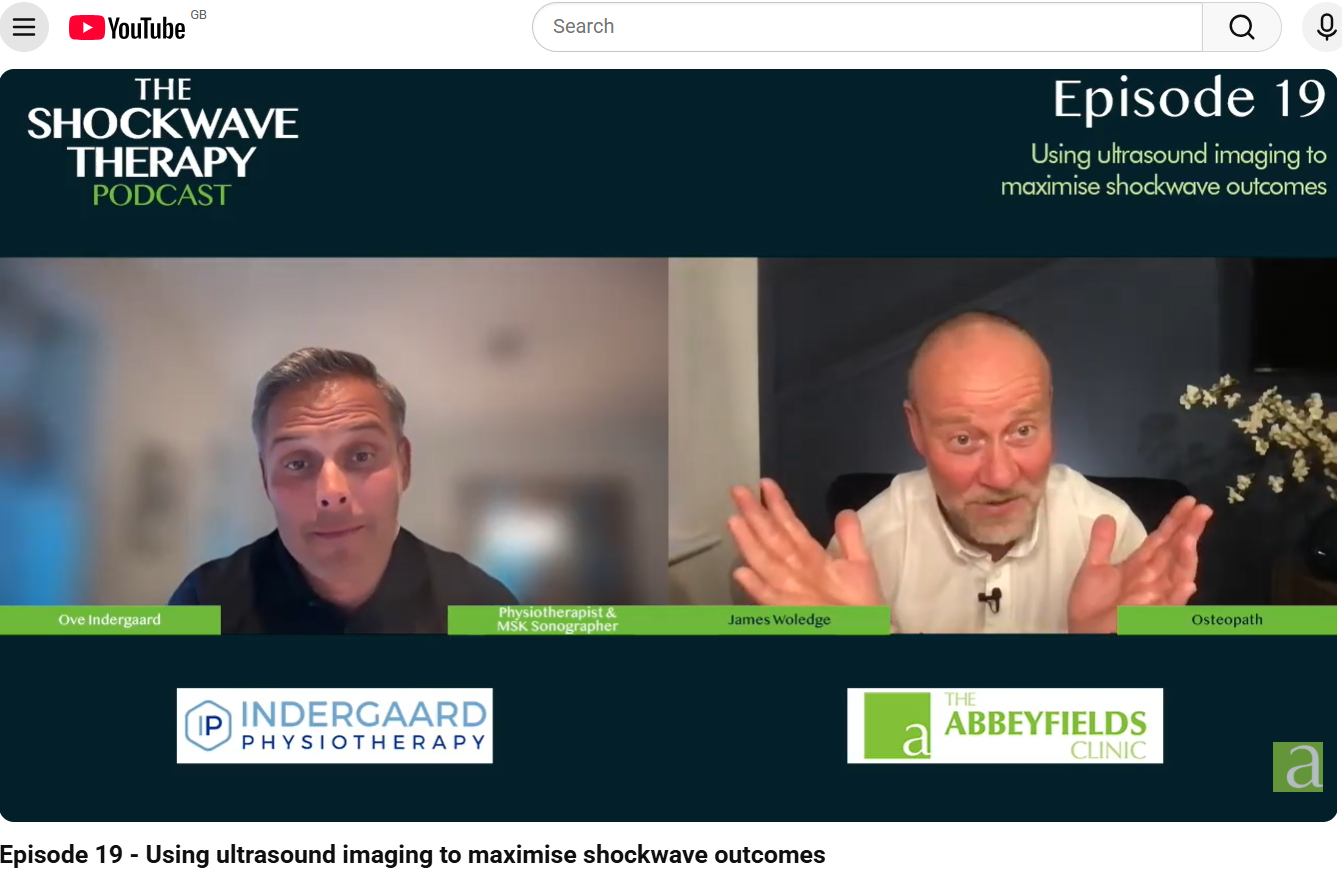
In this episode of the Shockwave Therapy Podcast, James Woledge and Ove Indergaard discuss how point of care ultrasound, often referred to as POCUS, can support shockwave therapy and improve clinical decision making.
Watch the full podcast: Using ultrasound imaging to maximise shockwave outcomes.
Shockwave therapy works without ultrasound
It is important to say this clearly. You do not need ultrasound to use shockwave therapy effectively.
Many MSK clinicians achieve strong outcomes using clinical assessment, palpation and experience. Shockwave therapy remains a safe and evidence based treatment across a range of conditions including plantar fasciopathy, Achilles tendinopathy and calcific shoulder pain.
If you are new to this area, you can explore more about shockwave therapy systems here.
However, as cases become more complex or fail to respond, the limitations of working without imaging become more obvious.
Where point of care ultrasound adds value
Point of care ultrasound allows clinicians to assess soft tissue structures in real time during a consultation. Instead of relying purely on symptoms and palpation, you can begin to see what is happening within the tissue.
In the context of shockwave therapy, this can help you:
- Locate calcifications within tendons
- Identify partial tears or structural compromise
- Detect bursitis or fluid collections
- Assess tendon thickness and changes over time
- Recognise when multiple pathologies are present
This is where ultrasound guided shockwave therapy starts to become more relevant. It is not about replacing clinical skills, but about adding another layer of information.
You can learn more about MSK ultrasound systems here.
Better targeting is only part of the story
There is growing interest in ultrasound guided shockwave therapy, particularly for conditions such as calcific tendinopathy of the shoulder.
Research suggests that when shockwave is delivered more precisely to the pathological tissue, outcomes can improve. This is especially relevant when the structure is small, deep or difficult to localise clinically.
That said, the biggest benefit of point of care ultrasound is often not targeting alone. It is decision making.
Improving clinical decisions with ultrasound
Many MSK diagnoses are broad by nature. Terms such as rotator cuff related pain, Achilles tendinopathy or lateral elbow pain can cover a wide range of underlying issues.
For example, Achilles pain might involve:
- Mid-portion tendinopathy
- Insertional tendinopathy
- Retrocalcaneal bursitis
- Paratenon irritation
- Partial tendon tearing
- Neovascularisation
Each of these findings may change how you approach shockwave therapy. It may affect your energy settings, your loading programme, or whether shockwave is appropriate at all.
Point of care ultrasound helps refine these decisions.
Most patients present with more than one issue
One of the key themes from James’ podcast is how often patients have more than one pathology contributing to their symptoms.
A patient presenting with plantar heel pain may have:
- Plantar fascia thickening
- Fat pad changes
- Posterior tibial tendon overload
- Neural sensitivity around the tarsal tunnel
Without imaging, it is easy to focus on a single diagnosis. With ultrasound, you can start to build a more complete picture.
This is often the difference between a case that progresses steadily and one that plateaus.
Knowing when shockwave is not the right approach
Another advantage of using ultrasound alongside shockwave therapy is recognising when not to treat.
Situations where shockwave may not be the best first step include:
- Significant tendon tears
- Predominant bursitis
- Highly reactive or acute presentations
- Cases that require offloading or alternative intervention first
This improves patient selection and helps avoid unnecessary treatment.
Real world use of point of care ultrasound and shockwave therapy
In the podcast, James Woledge, clinical director of The Abbeyfields and The Bay Clinics, and Ove Indergaard share how ultrasound has changed their approach to MSK care.
Ove runs clinics across Leeds, Manchester and the Wirral, where point of care ultrasound is used routinely to support assessment and treatment planning.
Both clinicians highlight a similar shift. Ultrasound has not replaced their clinical skills, but it has improved their ability to:
- Select the right patients for shockwave therapy
- Identify the key pathological structure
- Adjust treatment based on findings
- Understand why some cases fail to respond
Do you need a PGCert to use point of care ultrasound?
Not necessarily.
There is a clear distinction between full diagnostic MSK ultrasound and point of care ultrasound.
A full postgraduate qualification is typically required if you are:
- Providing formal diagnostic reports
- Communicating findings to other medical professionals
- Performing comprehensive MSK scans
Point of care ultrasound is different. It focuses on targeted scanning to support clinical reasoning within your own scope of practice.
Many MSK clinicians are now using POCUS in a focused way to:
- Confirm or question a working diagnosis
- Guide treatment decisions
- Improve patient communication
Like any skill, it requires training and repetition, but it does not always require a full postgraduate pathway.
Technology is making ultrasound more accessible
Ultrasound is no longer limited to hospital environments.
Modern systems such as VINNO ultrasound are making high quality imaging more accessible to MSK clinics. This allows clinicians to integrate point of care ultrasound into everyday practice without the traditional cost barriers.
For clinics already offering shockwave therapy, ultrasound is increasingly being considered as a way to improve consistency and confidence in treatment delivery.
Explore ultrasound systems from Venn Healthcare.
Explore ultrasound and shockwave options for your clinic
If you are looking to develop your shockwave service or understand how point of care ultrasound could fit into your MSK clinic, Venn Healthcare can support you with equipment, training and practical clinical education.
Frequently asked questions
Do I need ultrasound to use shockwave therapy?
No. Shockwave therapy can be delivered effectively without point of care ultrasound. Imaging becomes more useful in complex or non-responsive cases.
What is point of care ultrasound?
Point of care ultrasound refers to focused scanning used during a clinical assessment to support decision making, rather than full diagnostic imaging.
Does ultrasound improve shockwave therapy results?
In certain conditions, particularly where accurate targeting is important, ultrasound can improve treatment precision and may lead to better outcomes.
Can physiotherapists use ultrasound in clinic?
Yes, many physiotherapists use point of care ultrasound within their scope of practice. Formal reporting and full diagnostic scanning require additional training.
Is ultrasound guided shockwave therapy better?
It can be, especially for conditions such as calcific tendinopathy where precise targeting is important. However, it is not essential for all cases.
Final thought
Shockwave therapy does not depend on ultrasound to be effective.
However, point of care ultrasound can help clinicians understand what they are treating, make better decisions and manage more complex cases with greater confidence.
If you can see what is happening in the tissue, it becomes much easier to explain, plan and deliver treatment.