The role of shockwave therapy in the treatment of Achilles tendinopathy has long been accepted as an effective, first line treatment by practitioners and researchers alike. A debate however has recently been reignited by a new randomised controlled trial (RCT) conducted by Alsulaimani et al. (2024), which concluded that shockwave therapy offers no significant benefit over placebo for this condition. Such findings have stirred considerable interest within the medical community, given the widespread use of shockwave therapy and the substantial anecdotal and clinical evidence suggesting its efficacy. The study’s conclusions challenge the practices of thousands of clinicians worldwide who have reported consistent success in using this modality to alleviate pain and promote recovery in patients with Achilles tendinopathy.
What’s really going on?
When a recent trial challenges established practice, it’s tempting to dramatically shift our clinical approach. But in the complex world of tendinopathy management, single trials rarely tell the complete story. This is particularly true for Achilles tendinopathy, where patient presentations vary dramatically, and treatment responses can be equally diverse.
The advantage of shockwave therapy has always been its elegant simplicity: non-invasive, relatively painless, and remarkably safe. Unlike corticosteroid injections that risk tendon degradation, or surgery with its lengthy recovery periods, shockwave therapy has offered hope for patients stuck in the frustrating gap between conservative care and invasive interventions.
But does it actually work? The answer requires us to look beyond headlines and dive deeper into the evidence. Let’s explore what the latest research really tells us about this controversial yet widely-used treatment, and why the location of your patient’s Achilles pain might matter more than you think…
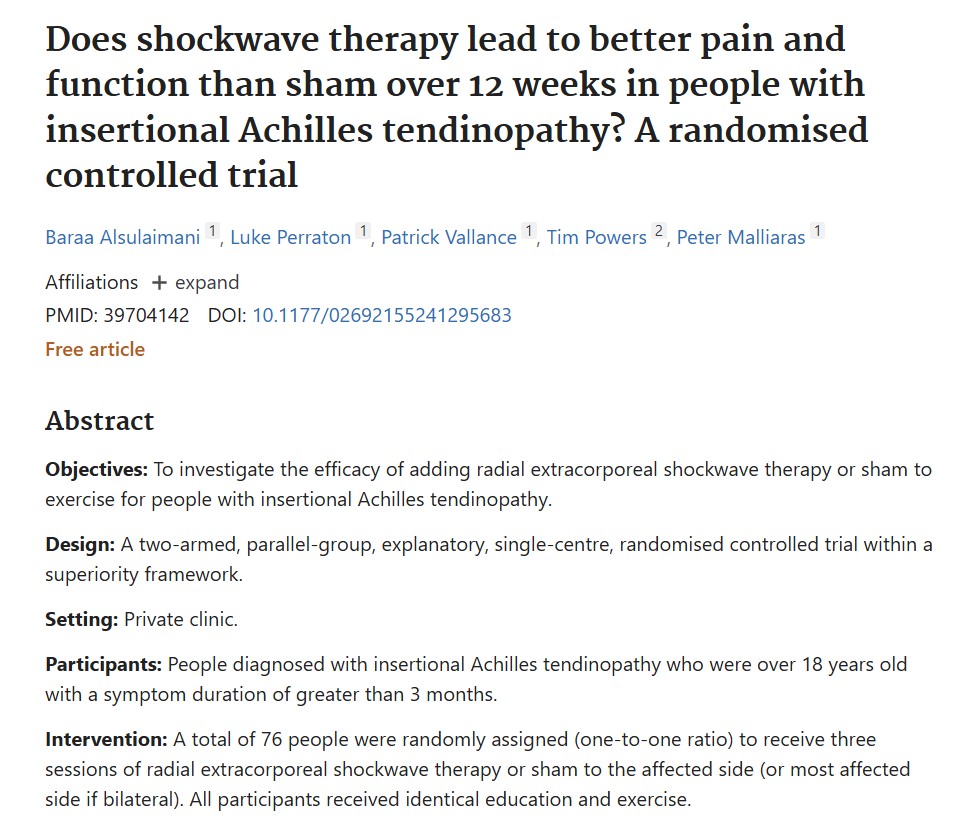
Does shockwave therapy lead to better pain and function than sham over 12 weeks in people with insertional Achilles tendinopathy? A randomised controlled trial by Alsulaimani et al (2024)
This recent trial by Alsulaimani et al. compared shockwave therapy versus sham treatment in 76 participants with insertional Achilles tendinopathy, with both groups receiving identical education and exercise. While methodologically sound, the study found no significant between-group differences in pain or function at 6 or 12 weeks. However, several important limitations warrant consideration.
The high pain levels in the sham group (3.22/10) may have triggered pain modulation effects, potentially compromising the true placebo comparison. The unblinded treatment providers introduced possible performance bias, while the fixed treatment parameters prevented protocol optimisation.
As a single-centre study focused solely on insertional tendinopathy, the results cannot be generalised to mid-portion cases. These limitations, combined with contrasting findings from systematic reviews demonstrating benefit across multiple studies, suggest clinicians should be cautious about dramatically changing practice based on this trial alone.
Evidence from Systematic Reviews
The systematic reviews by Al-Abbad (2013) and Fan (2020) provide compelling evidence supporting shockwave therapy’s effectiveness for Achilles tendinopathy. Fan’s meta-analysis demonstrated significantly better pain and functional outcomes across multiple validated measures, including VAS pain scores, VISA-A, and AOFAS scores.
Importantly, these benefits were sustained in both short-term (<6 months) and longer-term follow-up periods, addressing a key limitation of single trials with brief follow-up periods. Regarding treatment parameters, both reviews found comparable effectiveness between low-energy (0.06-0.11 mJ/mm²) and medium-energy (0.12-0.25 mJ/mm²) protocols, typically delivered over 3-4 sessions.
This flexibility in energy levels, combined with minimal reported adverse effects, suggests shockwave therapy can be safely optimised for individual patient needs. The reviews also highlighted important distinctions between insertional and non-insertional tendinopathy responses, with subgroup analyses revealing potentially different treatment effects based on anatomical location. This comprehensive analysis of multiple trials provides stronger evidence for clinical decision-making than single-trial results alone.
Insertional vs Mid-portion Achilles Tendinopathy
Insertional and mid-portion Achilles tendinopathy represent distinct clinical entities with fundamentally different pathophysiological mechanisms. Insertional tendinopathy involves the tendon-bone interface with often associated calcification and bone spurs, while mid-portion pathology typically presents 2-6cm proximal to the calcaneal insertion with different tissue characteristics and loading patterns.
These anatomical and pathological differences help explain varying treatment responses observed in research. Fan’s meta-analysis revealed different outcomes between insertional and non-insertional cases treated with shockwave therapy, suggesting location-specific treatment protocols may be necessary.
The clinical implications are significant; treatment approaches should be tailored accordingly, with careful consideration of anatomical location when interpreting research findings and planning interventions. This anatomical distinction particularly matters for shockwave therapy, where wave propagation and tissue response may differ between insertional and mid-portion locations. Therefore, the results from Alsulaimani’s trial on insertional cases cannot be automatically applied to mid-portion tendinopathy management.
Safety Profile of ESWT in Achilles Tendinopathy
Shockwave therapy stands out for its remarkable safety profile in treating Achilles tendinopathy, with systematic reviews consistently reporting only minor, transient side effects like temporary skin reddening. This contrasts sharply with more invasive options – corticosteroid injections carry risks of tendon degradation, rupture, and infection, while surgery involves inherent risks of wound complications, nerve damage, and prolonged rehabilitation periods.
The long-term safety record of shockwave therapy is particularly compelling, with studies like Fan’s meta-analysis showing no serious adverse events across multiple trials. Alternative treatments like high-volume injections or platelet-rich plasma require careful consideration of infection risk and potential complications.
Furthermore, unlike injections or surgery which may have permanent tissue effects, any minor discomfort from shockwave therapy typically resolves within 24-48 hours with no lasting impact. This exceptional safety profile, combined with its non-invasive nature, makes shockwave therapy an attractive option before considering more aggressive interventions, particularly in recalcitrant cases where conservative measures have failed.
Clinical Decision-making
Clinical decision-making for shockwave therapy in Achilles tendinopathy should be guided by a synthesis of the best available evidence, not single trials alone. Patient selection is crucial – considering factors like tendinopathy location (insertional vs mid-portion), duration of symptoms, previous treatment responses, and contraindications.
Treatment parameters can be optimised based on systematic review findings, with both low and medium-energy protocols showing effectiveness when delivered over 3-4 sessions.
The key is regular monitoring of outcomes using validated measures like VISA-A and VAS pain scores to assess treatment response and adjust protocols accordingly. Integrating regular reassessment with evidence-based protocols allows for personalized treatment progression, ensuring optimal outcomes for each patient. This systematic approach, combined with shockwave’s favourable safety profile, provides a structured framework for clinical implementation.
Conclusion
While Alsulaimani’s recent trial raises important questions, the broader evidence base supports shockwave therapy as a safe and effective treatment option for Achilles tendinopathy. Systematic reviews demonstrate sustained benefits with minimal adverse effects, particularly when compared to more invasive alternatives.
In the treatment algorithm, shockwave therapy offers a valuable intermediate option between failed conservative care and surgery. Future research should focus on optimising treatment parameters, investigating long-term outcomes beyond 12 weeks, and better understanding the differing responses between insertional and mid-portion tendinopathy.
Additionally, studies exploring combination therapies and identifying patient subgroups most likely to benefit would help refine clinical decision-making. Until then, clinicians should consider the totality of evidence when making treatment decisions, recognising that single trial results, while important, should be interpreted within the context of the broader evidence base.
References
Alsulaimani, B., Perraton, L., Vallance, P., Powers, T. and Malliaras, P., 2024. Does shockwave therapy lead to better pain and function than sham over 12 weeks in people with insertional Achilles tendinopathy? A randomised controlled trial. Clinical Rehabilitation, p.02692155241295683.
Al-Abbad, H. and Simon, J.V., 2013. The effectiveness of extracorporeal shock wave therapy on chronic achilles tendinopathy: a systematic review. Foot & ankle international, 34(1), pp.33-41.
Fan, Y., Feng, Z., Cao, J. and Fu, W., 2020. Efficacy of extracorporeal shock wave therapy for achilles tendinopathy: a meta-analysis. Orthopaedic Journal of Sports Medicine, 8(2), p.2325967120903430.