Clinical insight
Recovery is no longer passive rest
In a recent interview with FC Business Magazine, Richie Porter shared his insights into the evolving physical demands of elite football and the growing role of recovery technologies such as EMTT and shockwave therapy.
Richie brings more than 20 years of experience from Everton FC’s medical team, alongside expertise in podiatry, biomechanics and musculoskeletal care across Premier League and European competition.
The modern game
Football has changed — but not in the way many think
Fixture congestion is often blamed for the increasing physical burden placed on footballers. Yet, according to Porter, elite teams have always faced demanding schedules.
The real change is intensity.
Today’s footballer covers more high-speed metres, performs more explosive transitions and is expected to maintain intensity for longer periods. Although squads are larger, managers still rely heavily on a core group of key players, meaning those athletes carry significant cumulative load across the season.
Performance strategy
Recovery is now a performance strategy
At elite level, recovery is no longer viewed as passive rest. It is a central pillar of performance.
Without adequate recovery, injury risk rises, training quality declines and match performance can deteriorate. Improvement only occurs when players are physically capable of tolerating the demands placed upon them.
For MSK clinicians, this means recovery strategies must support not only tissue healing, but also repeatability, resilience and sustained performance.
Where recovery falls short
The issue is rarely lack of resources
Elite clubs have access to world-class facilities, advanced monitoring systems and multidisciplinary expertise.
The real issue is consistency. Some athletes still view recovery as something that only happens within the training ground environment.
However, recovery behaviours away from the club — sleep quality, nutrition, hydration, stress management and lifestyle habits — may have just as much influence on performance and injury risk.
“Players need to understand early that recovery is part of performance.”
Technology and judgement
The role of technology in elite recovery
GPS systems and wearable devices now provide detailed information on sprint exposure, acceleration profiles, total distance and cumulative load. These insights help sports science and medical teams individualise training and identify potential injury risks earlier.
But data alone is not enough. Objective data must be balanced with clinical reasoning, athlete feedback and practical experience.
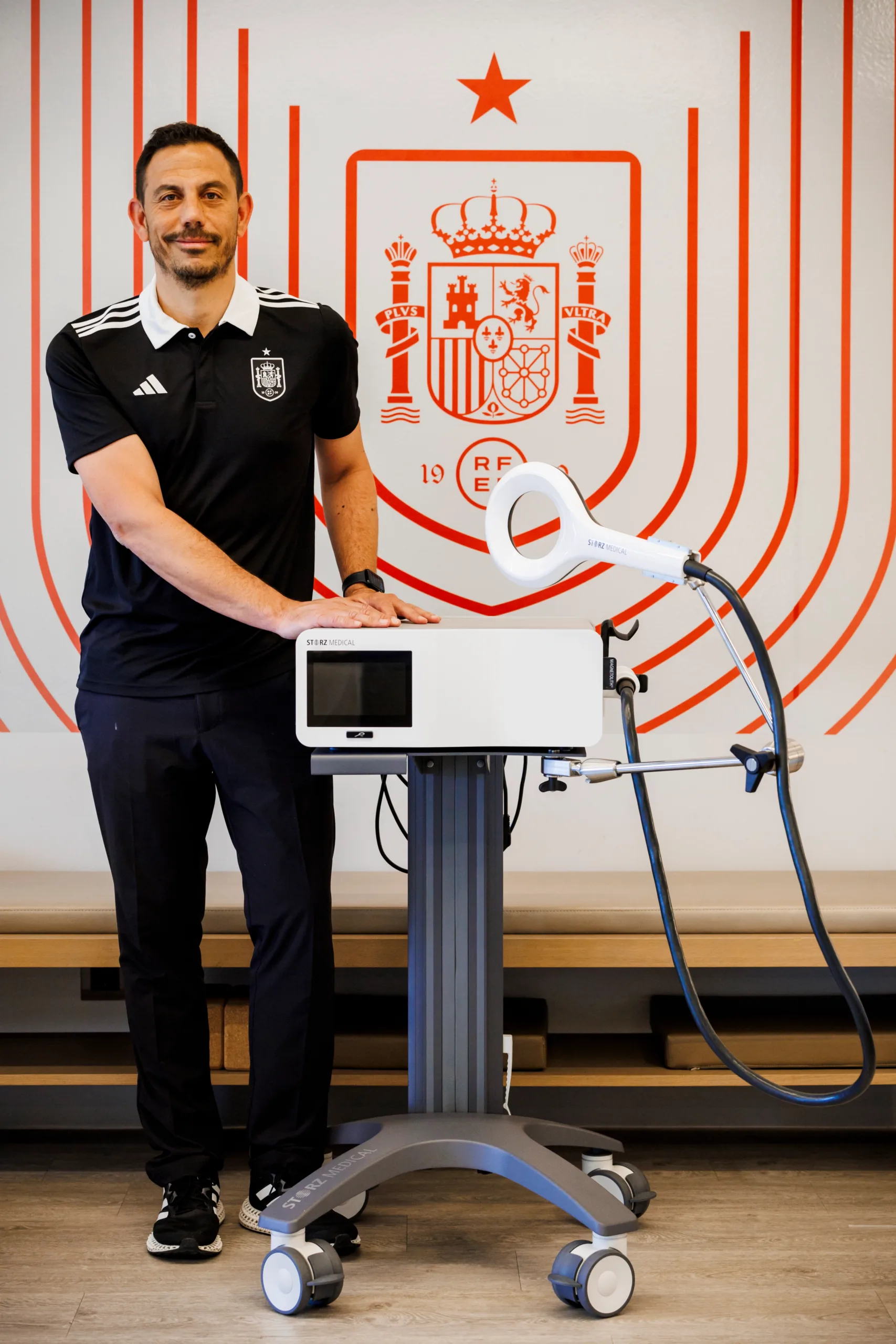
What is EMTT?
Extracorporeal Magnetotransduction Therapy
EMTT is a non-invasive treatment that uses high-frequency electromagnetic oscillations to influence tissue at a cellular level.
The proposed mechanism is centred around supporting cellular function and enhancing local metabolic activity to assist the body’s natural healing processes.
Elite sport adoption
Why EMTT is gaining attention in elite sport
Modern football requires recovery interventions that are practical, scalable and easy to integrate around training and competition schedules.
EMTT fits naturally within this model. Sessions are hands-free, efficient and easy to integrate into busy sporting environments where treatment time is limited.
Unlike some modalities, EMTT produces no thermal effect, allowing it to be used in both acute and chronic situations depending on clinical objectives and tissue presentation.
Before activity
Preparing tissue
EMTT may be used as part of preparation strategies where clinicians are looking to support tissue readiness and manage symptoms around training or competition.
After activity
Supporting recovery
EMTT may also be integrated into recovery workflows where the goal is to support tissue recovery, reduce treatment burden and maintain athlete availability.
Complementary technologies
EMTT and shockwave therapy
Shockwave therapy is already widely established within MSK practice, particularly for tendon and fascial conditions. EMTT adds another dimension to non-invasive treatment options.
While shockwave therapy delivers mechanical acoustic energy, EMTT uses electromagnetic oscillations to influence biological processes at a cellular level.
The important point is not choosing one modality over another, but understanding where each technology may fit within a wider rehabilitation and return-to-play strategy.
“Recovery needs to be treated with the same importance as training. It is not a lighter day; it is fundamental to performance.”
Speak to us
Looking for more information about EMTT?
If you would like to learn more about EMTT technology, clinical applications or integrating EMTT into your clinic, sports environment or rehabilitation setting, our team would be happy to help.