What initially interested you about NESA?
I first heard about it at one of the Venn conference days – got swept away by the enthusiasm! Had it been any other company I would not have engaged, but I trust Venn’s judgement on things technological.
Did you have any prior experience or awareness of neuromodulation?
No, this is my first time using a neuromodulatory device.
What kind of conditions are you expecting NESA to enable you to treat? Are there any conditions you currently treat that NESA might be part of a combination therapy for?
Expecting to treat sleep problems, anxiety, chronic pain, neuralgia (Mortons, facial), migraine, headache, peripheral neuralgia, urogynaecological problems and some digestive issues.
How have initial treatments gone, have you seen positive results? If so, what kind of improvements?
Still a small take up of treatment but so far doing well with insomnia, peripheral neuropathy, Morton’s neuroma and cramp (see below).
Have you tried the device on yourself? How have you found it?
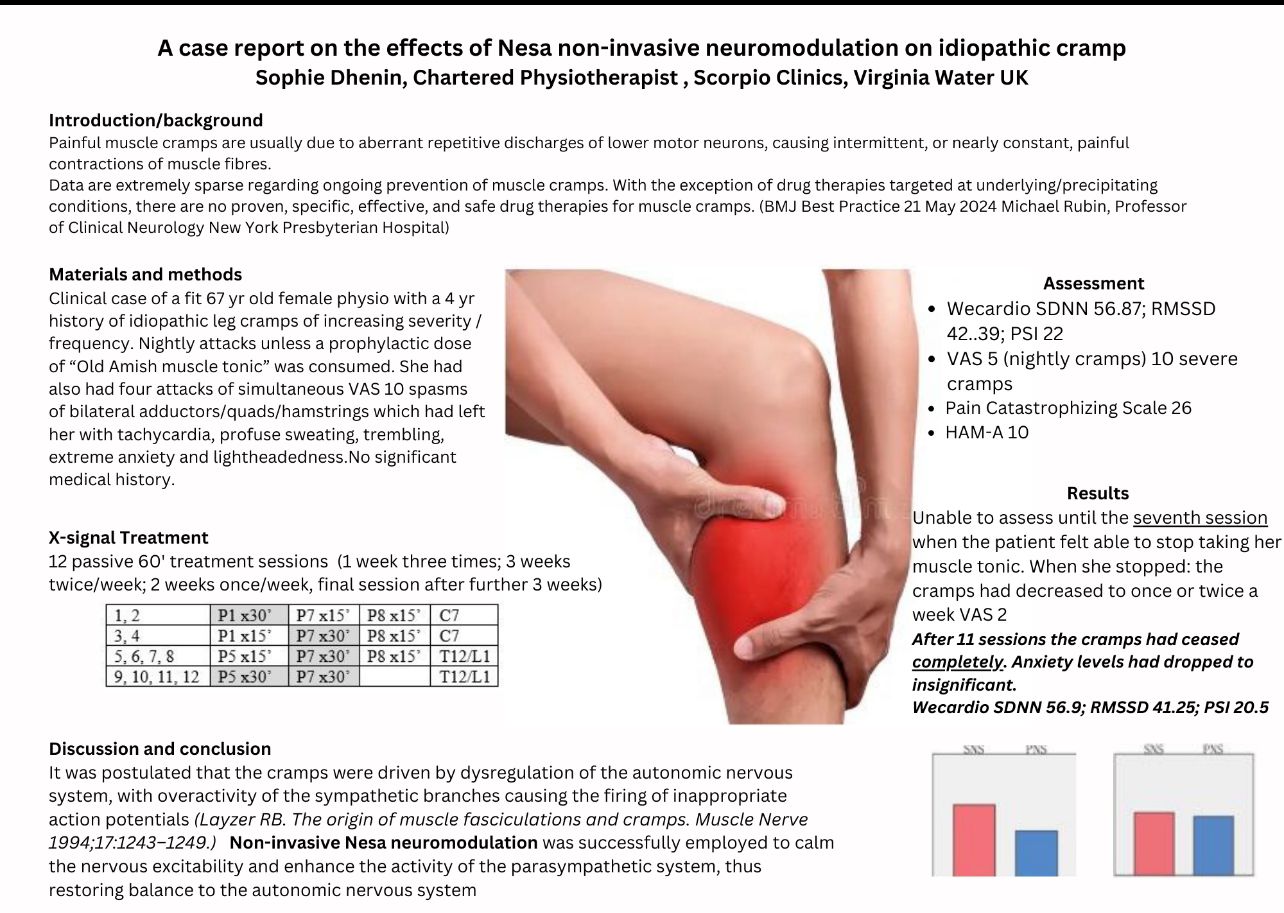
I treated myself for cramp. I have a four year history of increasingly severe leg cramps which (if I don’t take a certain magic potion) will force me out of bed up to 6-7 times a night. I have also had four episodes of terrifying bilateral quads/hams/abductor cramp which has had me screaming with pain for up to 10 minutes and left in shock afterwards. Lots of medical tests but no medical explanation. I asked the NESA if they thought I could treat it with X-SIGNAL. They thought not: but I reasoned that it could well be an autonomic dysregulation and decided it was worth a bash.
Twelve sessions with the X-SIGNAL and I have been cramp-free (without my potion) for almost two months! I am totally blown away and hugely relieved. I moved on to treating my Morton’s neuroma and it’s 90% resolved with an extra four sessions on top of that original twelve. I plan to target my poor lower limb proprioception next.
Have patients enjoyed the treatments? How many treatments are they typically coming for?
We are only at the very beginning so patients have only had 2-4 sessions. People often go to sleep.

What was it like integrating NESA into your clinic?
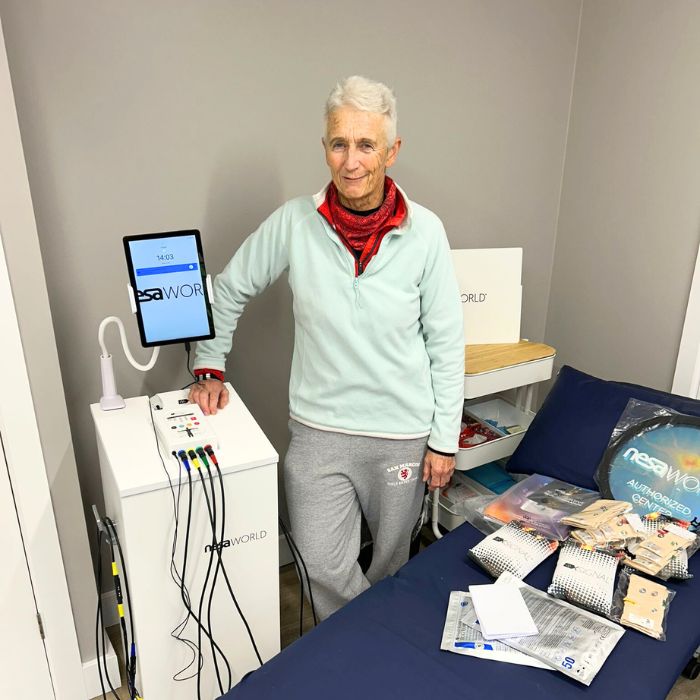
It’s a journey. We have had our unit for a couple of months and there’s a lot of learning to do before you gain the confidence to use it. The basic course is 30 hours’ online study and it’s wise for at least one person in the clinic to do the advanced course which is I think 150 hours. At times it’s a bit of a slog but it’s well worth the effort (I was that nominated person!).
There are important practical considerations which I wasn’t really aware of until I was in the thick of things. Each NESA treatment is an hour long plus the fiddling around on either side so the patient is in the clinic for a minimum of an hour and a quarter. You need to have the room capacity to cope with this. We run half hour appointment times so it can be messy. Fortunately we had just built an overflow room so we are planning for the physio to meet/greet/assess and make the appropriate clinical decison about electrode placement and programming – and to set the thing going. Then one of our receptionists will sort the patient out at the end of the session and prepare the room for the next client. The NESA room will therefore run on an hour and a half blocks. Pricing structure has been difficult but taking into account all of the above plus the cost of a personal set of electrode gloves and socks, we settled on £1500 for a package of 10 sessions. Patients balk at this until we explain the breakdown.
I am still at the stage of chatting to people in the clinic, at the gym etc and drip-feeding info about the X-SIGNAL to them. Everyone “has a friend” who might be interested but because it’s such a new treatment people are reluctant to try.
The NESA website is superb and there are loads of bite-sized clinician and patient testimonials (with English subtitles). If anyone I speak to expresses an interest I send them an email with info plus a couple of appropriately selected testimonials to mirror their particular problem or pathology.
Would you say you expect it to be a successful investment for your clinic?
I am very excited. I think take-up is and will be slow but once we get going I suspect there might be an avalanche of patients. I am confident it will prove to be a successful investment and even if I never treated anyone else with it – it would be worthwhile just for my own consumption!
What would be your advice to fellow practitioners who are considering NESA?
The room issue described above is paramount. This treatment cannot be rushed. Usually patients will start with two visits a week for the first couple of weeks but that could even be 3-4 sessions a week. You need to be able to accommodate that. Expect the learning process and the introduction to be slow so you need to be patient. Happy to chat to anyone who wants further advice.