Imagine not being able to brush your hair, reach for a coffee mug, or put on a seat belt – everyday movements most of us take for granted.
For millions of people suffering from frozen shoulder, these simple actions become painful, frustrating battles. The condition, which affects up to 5% of the population, doesn’t just limit movement; it can hijack your independence and quality of life.
But what if there was a treatment that could break through this barrier of pain and stiffness without surgery or lengthy rehabilitation? A treatment that could help restore your shoulder’s freedom of movement in just four sessions?
Multiple clinical trials have shown promising results about radial shockwave therapy (rSWT), a non-invasive treatment in the management of frozen shoulder sufferers.
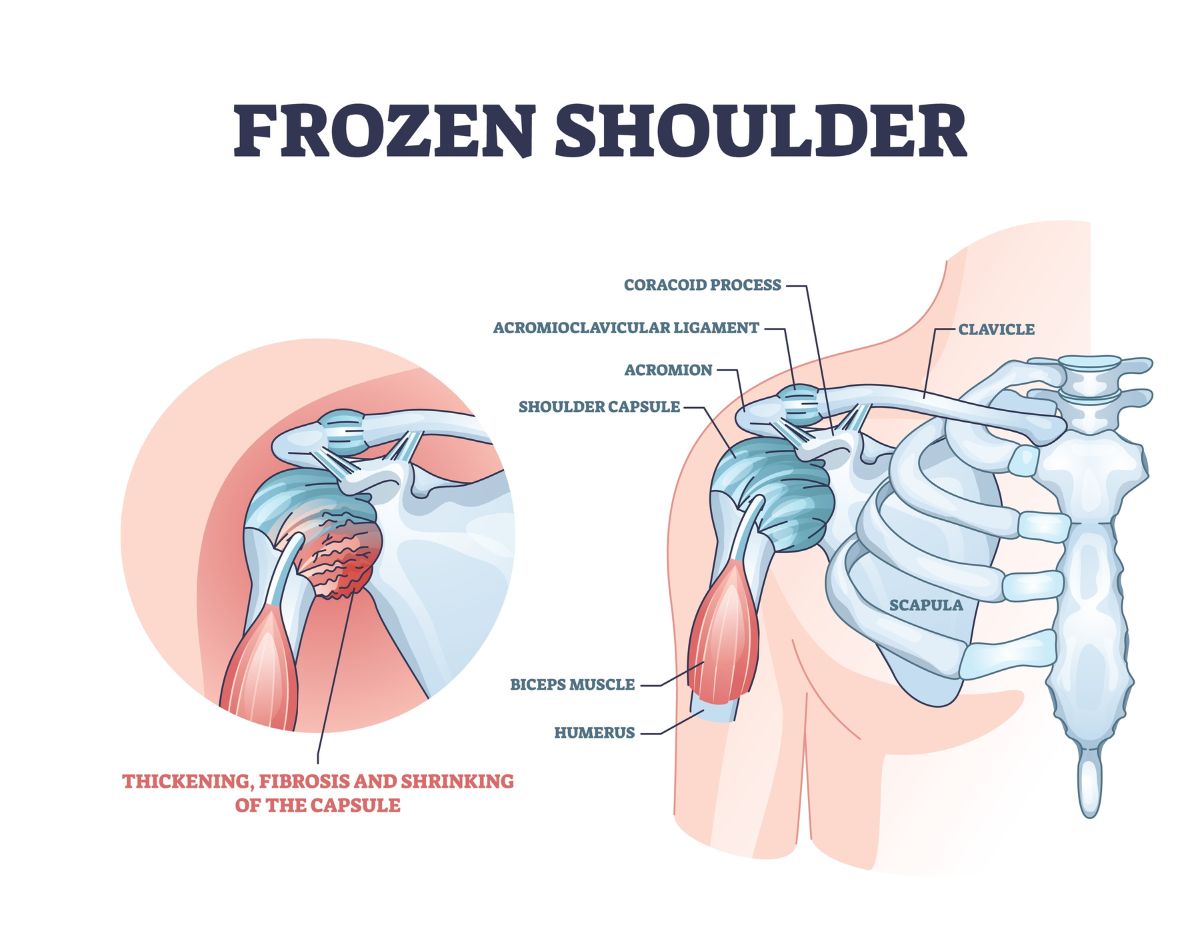
For Sarah, a 48-year-old office worker who struggled with frozen shoulder for over a year, traditional treatments had provided little relief.
“I tried everything – physiotherapy, painkillers, cortisone shots. Nothing seemed to make a real difference,” she shares. “I was starting to lose hope of ever getting back to normal.”
Sarah’s story mirrors countless others, but there’s now reason for optimism. This safe and non-invasive treatment could offer new hope for the thousands of people currently limited by frozen shoulder.
In a study of 106 patients, this non-invasive approach showed remarkable success in reducing pain and restoring mobility, with benefits lasting six months or longer. Let’s explore this prospective, randomised, double-blind, placebo-controlled trial by Hussein et al (2015) which had shown the efficacy of radial extracorporeal shockwave therapy in shoulder adhesive capsulitis.
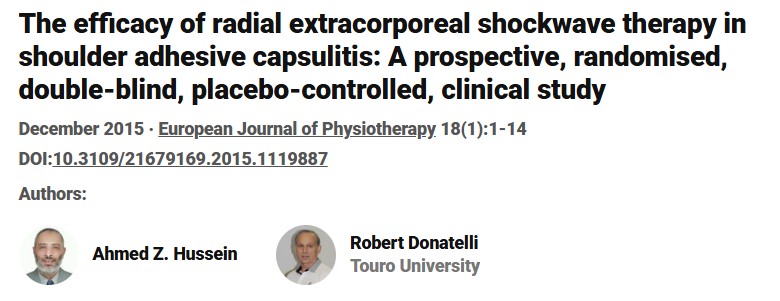
The efficacy of radial extracorporeal shockwave therapy in shoulder adhesive capsulitis: a prospective, randomised, double-blind, placebo-controlled, clinical study.
Participants
- Total: 106 patients
- Distribution: Randomly divided into 2 groups
- Experimental Group: 53 patients (received real rSWT)
- Control Group: 53 patients (received placebo treatment)
- Demographics:
- Gender: 66 women, 40 men
- Age Range: 39-77 years
- Symptom Duration: 9-14 months (At least 6 months)
- Treatment History: No treatment except analgesics in past 3 months
- Imaging: No significant findings on shoulder radiographs
Exclusion criteria
(Bilateral shoulder involvement, Previous shoulder surgery, Shoulder fracture, Cancer, Arthritis (glenohumeral or acromioclavicular), Inflammatory disorders, Diabetes mellitus, Severe osteoporosis, Pulmonary diseases, Neuromuscular disorders, Pregnancy, Implanted pacemaker).
Treatment protocol
- Treatment Settings
- 2000 impulses per session
- Air pressure: Up to a maximum of 3.5 bars
- Frequency: 8 Hz
- Applicator size: 15 mm
- Application Method
- 4 weekly sessions
- Treatment locations:
- 1000 impulses anterior to posterior
- 1000 impulses posterior to anterior
- Home exercise program provided to both groups
Outcome measures
Results
The treatment group showed remarkable improvements across all outcome measures
The treatment protocol was both efficient and safe, requiring only four weekly sessions with minimal side effects (5.6% minor hematomas). These significant improvements were maintained at 6-month follow-up, demonstrating the treatment’s durability. The study establishes rSWT as a safe, effective, and non-invasive treatment option for frozen shoulder. Given its impressive outcomes and minimal risk profile, rSWT should be considered as a valuable treatment alternative before proceeding to more invasive interventions such as injections or surgery. Further research with longer follow-up periods and larger patient populations would be beneficial to establish long-term outcomes and optimal treatment protocols.
What sets rSWT apart is its unique combination of clinical efficacy and practical advantages:
Conclusion
As healthcare professionals treating frozen shoulder, we’ve all experienced the frustration of limited treatment options and variable outcomes. Traditional conservative approaches often require months of therapy, while corticosteroid injections provide temporary relief at best and might not be sutiable for everyone. Surgery, though effective, carries inherent risks and significant recovery time – making it a last resort rather than a preferred solution.
As we continue to seek optimal outcomes for our patients with frozen shoulder, rSWT deserves consideration as a safe and effective treatment option. The combination of significant clinical improvement, minimal risk, and practical implementation makes it a valuable addition to our therapeutic arsenal. For our patients struggling with this debilitating condition, it offers hope without compromise, and for us as clinicians, it provides a powerful tool to deliver the outcomes we strive for.
Author:
Benoy Mathew, MSc, MCSP,
Advanced Practice Physio/MSK Sonographer,
Head of MSK Education, Venn Healthcare
Twitter: @function2fitnes Instagram: @function2fitness
Hussein et al (2016). The efficacy of radial extracorporeal shockwave therapy in shoulder adhesive capsulitis: a prospective, randomised, double-blind, placebo-controlled, clinical study. European Journal of Physiotherapy, 18(1), pp.63-76.